
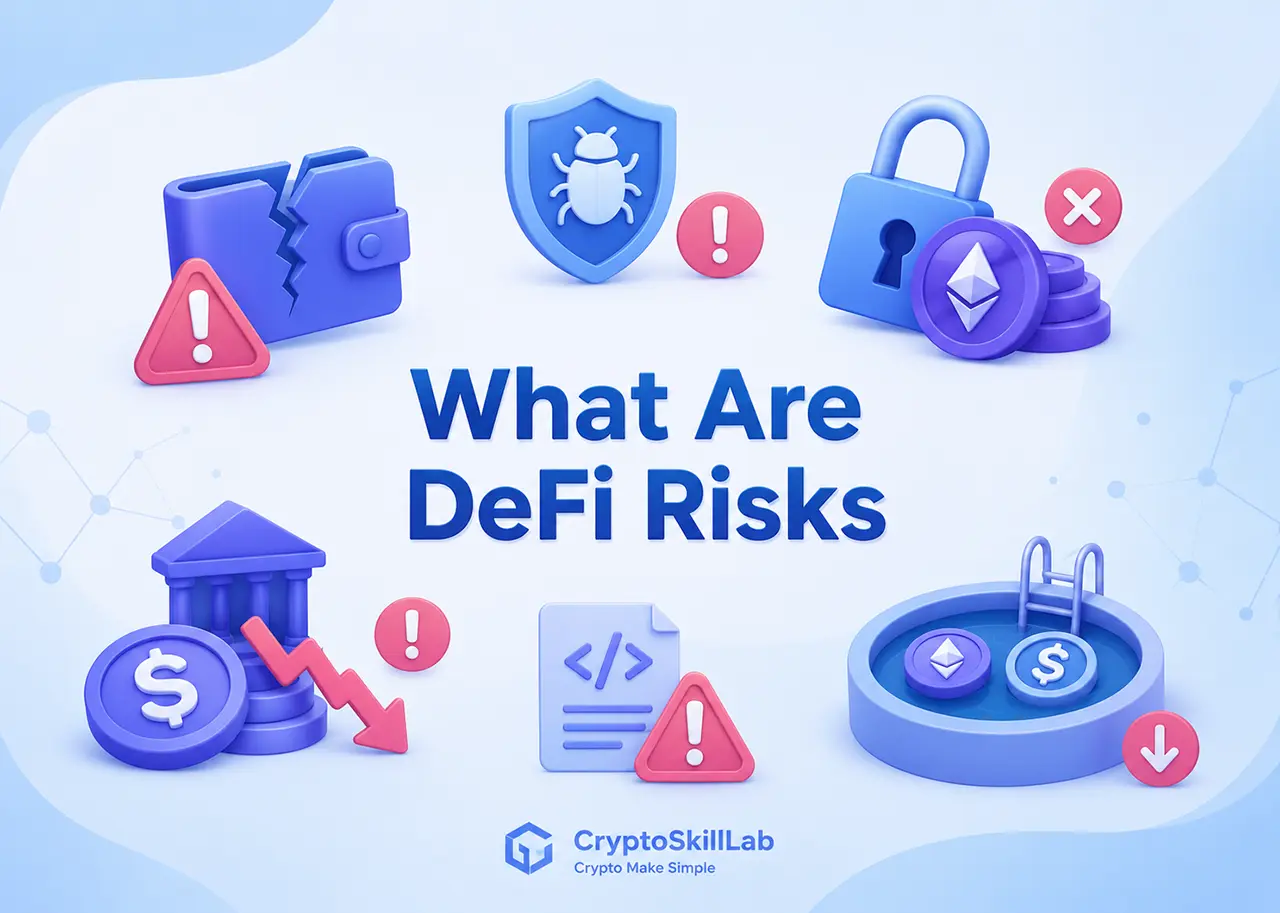
What Are DeFi Risks? Beginner’s Guide
If you are just getting into decentralized finance, you have probably seen plenty of exciting topics such as staking, lending, liquidity pools, and yield farming. But there is another side of DeFi that is just as important to understand: DeFi risks.
DeFi can give people more control over their crypto and let them interact with financial applications without relying on a traditional middleman. At the same time, that freedom comes with more responsibility. You need to understand what you are using, what you are signing, and what could go wrong.
DeFi risks can come from many places. A smart contract could have a vulnerability. A fake website could trick you into connecting your wallet. A token could lose most of its value. You could also make a simple transaction mistake that is difficult to reverse.
That does not mean DeFi is automatically unsafe. It simply means that learning about DeFi risks should be part of learning about DeFi itself.
In this beginner-friendly guide, we’ll break down the most common risks in plain language, use simple examples, and go through practical steps you can take before using a DeFi application.
What Is DeFi?
DeFi stands for decentralized finance. It refers to blockchain-based applications that provide financial services such as token swapping, lending, borrowing, staking, and liquidity provision.
Instead of relying entirely on a traditional financial institution, many DeFi applications use smart contracts to carry out programmed instructions.
If cryptocurrency itself is still new to you, start with our beginner-friendly guide to what crypto is.
It is also useful to understand the technology behind these applications. You can learn more about what blockchain is and how it works before moving deeper into DeFi.
Once you understand those basics, the different types of DeFi risks become much easier to understand.
What Are DeFi Risks?
DeFi risks are the potential problems, losses, or security threats that people can encounter when using decentralized finance applications.
These risks can come from technology, markets, protocols, or even the user’s own actions.
For example, a user could encounter:
- A vulnerable smart contract
- A fake DeFi website
- A malicious token
- A sudden market crash
- Impermanent loss
- A compromised wallet
- A bridge exploit
- High blockchain transaction fees
- A protocol failure
- A simple transaction mistake
The important thing to remember is that not all DeFi risks are the same. Some are technical, some are financial, and others are related to security or user behavior.
Why Should Beginners Understand DeFi Risks?
DeFi applications can make complicated technology feel surprisingly simple.
You might connect your wallet, select a token, click a button, and approve a transaction in just a few seconds.
Behind that simple interface, however, there may be smart contracts, token contracts, liquidity pools, price oracles, bridges, and other systems working together.
If something goes wrong with one of those components, users can potentially be affected.
There is another important difference to remember: blockchain transactions are generally difficult to reverse once they have been confirmed.
That means a mistake that might be fixable with a traditional financial service could be much harder to correct in DeFi.
Understanding DeFi risks before using these applications can therefore save you from many avoidable problems.
1. Smart Contract Risk
Smart contracts are one of the main building blocks of DeFi.
A smart contract is essentially a program running on a blockchain. It follows rules written into its code and can automatically perform actions when certain conditions are met.
For example, a smart contract might handle token swaps, lending deposits, withdrawals, or liquidity positions.
The problem is that smart contracts are software, and software can contain bugs.
A vulnerability could potentially allow someone to manipulate a contract or access assets they should not be able to access.
This is one of the most important DeFi risks for beginners to understand.
Simple Example
Imagine a lending protocol with a programming error that incorrectly calculates how much collateral a user needs.
An attacker discovers the problem and uses it to borrow more assets than the system intended to allow.
The protocol might appear legitimate, but the underlying code could still have a weakness.
How Can You Reduce the Risk?

Before using a protocol, look for information about:
- Official documentation
- Smart contract addresses
- Security audits
- Bug bounty programs
- Previous security incidents
- Development activity
An audit can be useful, but an audit does not guarantee that a protocol is completely safe.
2. DeFi Scams and Fake Projects
Not every project claiming to be part of DeFi is legitimate.
Scammers can create fake websites, social media accounts, tokens, and applications that look surprisingly similar to real projects.
They may copy logos, use similar domain names, or promise unusually high returns to convince people to deposit their crypto.
This is one of the DeFi risks that beginners can encounter before making a single legitimate DeFi transaction.
Common Warning Signs
- Guaranteed profits
- Unrealistic APYs
- Pressure to deposit immediately
- Requests for your seed phrase
- Suspicious website domains
- Anonymous or unverifiable teams
- Fake giveaways
- Unknown wallet permissions
- Promises that you cannot lose money
A professional-looking website does not automatically make a project legitimate.
Always verify the official website and contract addresses through reliable sources before connecting your wallet.
DeFi risks can come from smart contract vulnerabilities, market volatility, scams, and mistakes made when using decentralized applications.
3. Wallet and Private Key Risks
Your wallet is one of the most important parts of your DeFi experience.
If someone gets access to your private key or seed phrase, they may be able to control the assets in that wallet.
There may not be a customer service department that can reverse the transaction for you.
That makes wallet security one of the biggest DeFi risks beginners should take seriously.
Never Share Your Seed Phrase
A legitimate DeFi application should not need your seed phrase to connect your wallet.
If a website, person, or support account asks you to enter your recovery phrase, stop immediately.
Your seed phrase should remain private and should never be entered into an unfamiliar website.
4. Malicious Token Approvals
When using DeFi applications, you may sometimes be asked to approve a token contract.
This approval can allow a smart contract to interact with a particular token in your wallet.
Users sometimes approve transactions without reading what they are actually authorizing.
A malicious contract or overly broad approval could potentially put your assets at risk.
This is another example of DeFi risks that can result from a simple wallet interaction.
A Safer Habit
Before approving a transaction:
- Check the website address.
- Confirm which token you are approving.
- Review the requested permission.
- Check the transaction details.
- Stop if anything looks unusual.
- Review and revoke unnecessary approvals when appropriate.
Taking an extra minute to check a transaction can be well worth it.
5. Cryptocurrency Market Volatility
Crypto prices can move quickly, sometimes in a very short period.
A DeFi position may involve one or several crypto assets, so the value of your position can change even when the protocol itself is working exactly as intended.
For example, you might receive interest or rewards while the underlying token loses value.
You could end up with more tokens but less total value.
This is one of the easier DeFi risks to understand because it is directly connected to cryptocurrency price movements.
Example
Suppose you deposit $1,000 worth of a crypto asset into a DeFi application.
Over time, you receive $50 worth of rewards.
However, the original asset falls in value and your deposit is now worth $700.
Even though you earned rewards, your overall position could still be worth less than the $1,000 you started with.
This is why rewards should always be considered alongside market risk.
6. Impermanent Loss
Impermanent loss is particularly important if you provide liquidity to a decentralized exchange.
Liquidity providers usually deposit a pair of assets into a liquidity pool so traders can swap between them.
When the relative prices of those assets change, the pool can automatically adjust the amount of each asset in your position.
Your final position may therefore be different from what you would have had if you had simply held the original assets in your wallet.
This is one of the more confusing DeFi risks for beginners because the word “impermanent” can make it sound harmless.
It is not necessarily harmless. The effect can become significant when asset prices move substantially.
7. Liquidity Risk
Liquidity describes how easily an asset can be bought or sold without causing a large change in its price.
A DeFi token or pool with limited liquidity can make it difficult to exit a position at the price you expect.
For example, you might see a token listed at $1, but there may not be enough buyers willing to purchase a large amount at that price.
If you try to sell a large position, the price could move significantly.
This is another important category of DeFi risks.
8. Oracle Risk
Some DeFi applications rely on price oracles to obtain information about asset prices.
Oracles provide external data to smart contracts.
If an oracle provides incorrect or manipulated information, a DeFi protocol could potentially make incorrect decisions.
For example, a lending platform might use an incorrect price when calculating the value of a user’s collateral.
Oracle design is therefore another technical area worth considering when evaluating DeFi risks.
9. Bridge Risks
Blockchain bridges allow users to move assets or information between different blockchain networks.
They can be useful, but they also introduce additional technical complexity.
A bridge may depend on several smart contracts, validators, or other components.
If one part of the system has a serious vulnerability, users may potentially be affected.
For this reason, bridge security is an important part of understanding DeFi risks when moving assets between networks.
A high APY does not mean a low-risk opportunity. Always understand how rewards are generated and what could happen if the market or protocol changes.
10. Governance Risks
Some DeFi protocols use governance systems that allow token holders to vote on changes.
Governance can be useful because it gives the community a role in how a protocol develops.
However, it also introduces another layer of risk.
A governance proposal could change fees, rewards, supported assets, or other important protocol settings.
In some systems, a relatively small number of wallets may control a large percentage of governance tokens.
Before using a protocol, learn how its governance works and who has the ability to make important changes.
11. Network Fees and Congestion
Blockchain networks can become busy.
When demand increases, transaction fees can rise.
This can be particularly noticeable for beginners working with smaller amounts.
For example, you might earn $10 in rewards but spend a significant amount on transaction fees to deposit, manage, and withdraw your assets.
Network costs are therefore another practical category of DeFi risks.
12. Stablecoin Risks
Stablecoins are widely used in DeFi because they are designed to maintain a relatively stable value compared with a reference asset.
However, stable does not mean risk-free.
Different stablecoins use different mechanisms to maintain their value, and those mechanisms can have their own risks.
A stablecoin could temporarily trade above or below its intended value.
If a DeFi strategy depends heavily on a stablecoin maintaining its value, this can become an important concern.
Understanding the specific stablecoin is therefore part of evaluating DeFi risks.
13. Token and Economic Design Risks
Many DeFi projects use their own tokens to encourage participation.
A protocol might distribute tokens to liquidity providers, stakers, or other users as incentives.
Attractive rewards can bring users into a protocol quickly.
But if a project creates a large amount of new reward tokens, the increased supply could put pressure on the token’s value.
This means a high reward rate does not automatically translate into a high real-world return.
When evaluating DeFi risks, look beyond the APY and learn how the token economy works.
14. Composability Risk
One of DeFi’s most interesting features is that protocols can interact with one another.
A user might deposit an asset into one protocol, receive a token representing that position, and then use that token in another application.
This can create powerful strategies, but it can also create additional dependencies.
If one protocol experiences a serious problem, another protocol that depends on it could potentially be affected.
This interconnected nature is one reason DeFi risks can sometimes be difficult to evaluate.
15. User Error
Not every DeFi loss is caused by a hacker or software bug.
Sometimes the problem is simply a mistake.
A user could:
- Send tokens to the wrong network.
- Enter the wrong wallet address.
- Approve the wrong transaction.
- Select the wrong token.
- Misunderstand a protocol.
- Set an unsuitable transaction parameter.
- Forget about network fees.
Because blockchain transactions can be difficult to reverse, user mistakes are among the most practical DeFi risks to understand.
How to Check a DeFi Project Before Using It
You do not need to be a blockchain developer to perform some basic research.
A simple checklist can help you slow down and make a more informed decision.
Step 1: Find the Official Website
Do not rely on a random advertisement, social media post, or message from a stranger.
Find the project’s official website through reliable sources and carefully verify the domain.
Step 2: Read the Documentation
Look for information explaining:
- What the protocol does
- How deposits work
- How withdrawals work
- How rewards are generated
- What fees apply
- What assets are supported
- What risks the project acknowledges
If you cannot explain what the protocol does after reading its basic documentation, consider doing more research before depositing funds.
Step 3: Check the Smart Contracts
Look for publicly available contract addresses and compare them with information provided by the official project.
Do not assume a contract is safe simply because it appears on a popular website.
Step 4: Research Security History
Look for information about audits, security incidents, bug bounty programs, and previous exploits.
A project’s history cannot guarantee future security, but it can give you useful information to consider.
Step 5: Research the Tokens
Learn about every token involved in the strategy.
Look at its purpose, supply, liquidity, volatility, and role within the protocol.
Step 6: Check the Fees
Calculate the costs involved before depositing.
Consider:
- Network fees
- Trading fees
- Deposit fees
- Withdrawal fees
- Slippage
- Other protocol charges
Step 7: Start Small
If you decide to use the protocol, consider starting with a small amount.
This gives you an opportunity to learn how the application works before exposing a larger amount of money.
A Simple DeFi Risk-Checking Tutorial
Let’s say you discover a new DeFi application offering rewards for depositing crypto.
Before using it, you could follow this process:
- Find the official website and verify the domain.
- Read the documentation and understand how the rewards are generated.
- Find out which smart contracts hold user funds.
- Research available audits and independent security reviews.
- Check whether the protocol has experienced previous exploits.
- Research the tokens and their liquidity.
- Calculate transaction and withdrawal costs.
- Review the wallet transaction carefully before signing.
- If you still decide to participate, start with a small amount.
- Monitor the position and stay aware of protocol updates.
This process cannot eliminate all DeFi risks, but it can help you avoid many unnecessary mistakes.
The best way to manage DeFi risks is to research the protocol, protect your wallet, verify transactions, and never use more than you can afford to lose.
How to Protect Yourself From DeFi Risks
You cannot remove every risk from DeFi, but you can develop better habits.
Use Strong Wallet Security
Keep your seed phrase private and store it somewhere secure.
For larger holdings, consider whether a hardware wallet is appropriate for your situation.
Verify Websites
Bookmark legitimate websites rather than relying on random links.
Pay attention to suspicious domains and small spelling changes.
Read Transactions
Do not blindly click “Confirm.”
Whenever possible, understand what your wallet is asking you to approve.
Avoid Guaranteed Returns
Be very cautious when someone promises guaranteed profits or claims that a DeFi investment cannot lose money.
Crypto markets can change quickly, and technical problems can happen unexpectedly.
Keep Your Software Updated
Use current versions of your wallet and other security tools whenever possible.
Separate Experimental Funds
Some users prefer keeping experimental DeFi activity separate from their long-term holdings.
This can help limit the potential impact if something goes wrong.
Learn Before You Deposit
Education is one of the simplest ways to reduce avoidable mistakes.
The more you understand about DeFi risks, the easier it becomes to recognize situations that deserve extra caution.
DeFi Risks vs. Traditional Finance Risks
DeFi and traditional finance are very different, but both involve risk.
Traditional financial services can involve:
- Market losses
- Fraud
- Counterparty risk
- Institutional failures
- Fees
- Regulatory changes
DeFi introduces additional risks such as:
- Smart contract vulnerabilities
- Wallet security problems
- Oracle failures
- Bridge exploits
- Token contract risks
- Blockchain network issues
The point is not that one system has risk while the other does not.
The types of risk are simply different, and understanding those differences can help you make better decisions.
Can DeFi Be Safe?
There is no simple yes-or-no answer.
No financial system is completely free from risk.
DeFi can provide useful tools and give people direct access to blockchain-based financial applications. However, users also take on more responsibility for understanding the applications they use.
Some protocols have extensive documentation, large communities, long operating histories, and established security practices.
Others may be brand new or difficult to evaluate.
The goal is not to find a DeFi application with zero risk. Instead, the goal is to understand the DeFi risks involved and decide whether you are comfortable with them.
Common DeFi Mistakes Beginners Should Avoid
Chasing Extremely High APYs
A huge APY can be tempting, but it may come with significant risk.
Ignoring Impermanent Loss
If you provide liquidity, make sure you understand how changes in token prices can affect your position.
Trusting Influencers Blindly
Someone promoting a DeFi project may have different goals or incentives than you do.
Do your own research before making a decision.
Ignoring Smart Contracts
If your assets are controlled by a smart contract, the code itself is part of the risk.
Putting Everything Into One Protocol
Concentrating all your assets in one application can increase your exposure to a single failure.
Forgetting About Exit Costs
Always consider what it may cost to withdraw or sell your assets.
Using Money You Cannot Afford to Lose
DeFi should not be treated as a guaranteed source of income.
Beginner’s DeFi Risk Checklist
Before using a DeFi application, ask yourself:
- Do I understand what this protocol does?
- Do I know where my assets will go?
- Have I verified the official website?
- Have I researched the smart contracts?
- Are security audits or reviews available?
- Has the protocol experienced previous exploits?
- Do I understand how rewards are generated?
- Do I understand the tokens involved?
- Have I checked liquidity?
- Do I understand the fees?
- Can I explain the main risks in my own words?
- Can I afford to lose the amount I am considering using?
If you cannot answer several of these questions, it may be better to spend more time learning before depositing funds.
Where Can Beginners Learn More About DeFi?
Reliable educational resources can make learning about DeFi much easier.
The Ethereum DeFi guide provides educational information about decentralized finance and related concepts.
For broader information about investing and digital asset risks, the Investor.gov education resources provide general educational material.
Always check the latest official documentation for a specific DeFi protocol because features, fees, smart contracts, and risks can change over time.
Final Thoughts
DeFi can be an exciting part of the cryptocurrency ecosystem. It gives users new ways to swap assets, provide liquidity, lend, borrow, stake, and interact with financial applications.
But understanding the opportunities is only half of the picture.
The other half is understanding DeFi risks.
Smart contract vulnerabilities, scams, wallet security problems, market volatility, impermanent loss, liquidity issues, oracle failures, bridge vulnerabilities, and user mistakes can all affect DeFi users.
The best approach for a beginner is not to rush toward the highest reward.
Take your time. Research the protocol. Understand the assets. Verify websites. Read transactions carefully. Start small. Most importantly, never assume that a high return means low risk.
As you learn more about DeFi risks, you will become better equipped to evaluate DeFi applications and make decisions based on knowledge rather than hype.
You do not need to understand everything on day one. Start with the basics, learn one concept at a time, and build your knowledge before taking on more complex DeFi strategies.